

Sine N. Just, Professor of Strategic Communication at Roskilde University and PI of the ADD project
In October 2024, a team of researchers from Google and the University of Oxford published an article in Science that reported on an experiment using AI as a moderation tool between people. In the experiment, the AI tool was intended to act as a mediator between individuals with widely differing views on difficult issues such as Brexit, climate change and immigration. The researchers called their AI tool the ‘Habermas Machine’ because, according to them, it was based on the German philosopher and sociologist’s theories on consensus-oriented deliberation. A key conclusion was that participants preferred the AI-generated moderation to that of humans.
I do not know whether Jürgen Habermas had heard about the machine named after him before his death in April 2026. But if he did, he would probably not be pleased. Firstly, he would argue that the concept of consensus on which the Habermas Machine operates is oversimplified. Secondly, Habermas would surely not have appreciated being turned into a machine.
One of Habermas’s central arguments is, in fact, that machine-like rationality threatens human relationships, or, to use his technical terms: that the system colonises the lifeworld. In other words, the form of rationality that governs society’s economic and administrative systems is, to an ever-increasing extent, encroaching on all areas of human existence and replacing meaningful communicative action with a utility-maximising logic of efficiency and profit. Money and power trump human relationships. From this perspective, AI technology, which operates based on probability calculations, cannot produce new meaning. It does not create anything new but colonises and exploits the people whose communication it has been trained on and which it imitates.
When and if the Habermas Machine produces more meaningful summaries of human debates than humans themselves, this is an indication of how far systemic colonisation has penetrated human life, not of how advanced AI technology has become. If people actually prefer machine summaries – of polarised debates, as in this example, or of other content such as AI-generated news – it must be because the very act of creating meaning has today become meaningless.
Since its first publication, Habermas’s theory of the public sphere has been central to discussions on how public debate can best be organised to strengthen democracy.
This point can be deduced from one of Habermas’s most recent contributions to the analysis of societal development. In 2022, the 60th anniversary of one of his earliest and most enduring analyses was marked by an update of what he had in 1962 described as the structural transformation of the public sphere. Since its first publication, Habermas’s theory of the public sphere has been central to discussions on how public debate can best be organised to strengthen democracy. And since then, the question has been what threatens this organisation – and how it can be (re)established.
In 1962, Habermas’s diagnosis was that the public sphere was under threat from professionalisation and commercialisation: The exchange of ideas and views that in the 18th century took place amongst the free citizens of the Enlightenment, who met in London’s coffee houses and Paris’s salons, had, in the European context of the 1960s, been taken over by advertising-funded media and orchestrated by professional political advisers and lobbyists.
Habermas’s diagnosis of the structural transformation of the public sphere can be seen as a precursor to the point about colonisation that he elaborated in The Theory of Communicative Action, just as it is closely linked to his theory of deliberative democracy. In these theories, Habermas sets out an ideal in which the public sphere acts as a mediator between citizens and the state, thereby ensuring the state’s legitimacy through the rational exchange of ideas. At the same time, he concludes that this ideal is threatened because the public sphere is failing to fulfil its mediating role.
As early as 1962, Habermas believed that democracy was under pressure from the decline of the public sphere, but in 2022 the situation of the 1960s had come to seem almost like a democratic utopia. In any case, the new reality – which Habermas believes is characterised by ‘a further structural transformation of the political public sphere’ – is a far more acute democratic crisis than what he described in 1962. In an essay marking the 60th anniversary of The Structural Transformation of the Public Sphere, Habermas diagnoses today’s public sphere as characterised by the fragmentation of opinion formation and by digital platforms’ lack of recognition of their democratic responsibility. In his view, the platforms should assume an editorial role and ensure the quality of the interaction they facilitate rather than give everyone free rein to say and think whatever they want in whichever way they please.
The result of digital platforms’ failure to fulfil their editorial responsibilities is that the contemporary media landscape cannot be described as a unified public sphere.
The result of digital platforms’ failure to fulfil their editorial responsibilities is that the contemporary media landscape cannot be described as a unified public sphere. Instead, public discourse takes place in a series of interest-driven ‘semi-publics’, where participants are not oriented towards the common good, but instead act as private individuals who neither perceive themselves nor behave as citizens. In their self-perception as users, citizens rally round specific interests and causes, as seen, for example, in Facebook groups covering everything from co-operative housing and day trading to water lilies and regional jokes. And although such groups may be viewed as digital community centres, they have little democratic value when viewed from the Habermasian perspective.
With barely concealed bitterness, Habermas, in his 2022 essay, compares the current situation to the invention of the printing press: “Just as printing made everyone a potential reader, today digitalisation is making everyone into a potential author.” But as he rhetorically asks: “how long did it take until everyone was able to read?” (Habermas, 2022: 160). In other words, digital platforms do not support citizens’ participation in the type of opinion formation that informs democratic processes. On the contrary, influence moves from the system to the citizens; public opinion is not merely controlled but replaced by money and power.
After this detour, we now arrive back at the participants in the experiment with the ‘Habermas Machine’. When they prefer a machine to a human being, this is, in Habermas’s understanding of the connection between democracy and deliberation, an indication that the connection has already been destroyed – and not proof that a machine can rebuild it. As Habermas sees it, the aim of deliberation is not consensus. Rather, the aim of public conversation is the conversation as such, the process of meaning formation. It is the exchange of views and arguments between people that has value, not the outcome on which they might eventually agree.
This is where I both agree and disagree most strongly with Habermas. I agree because machine-generated meaning-making is a contradiction in terms; people create meaning through their interactions with other people, and if the media landscape does not support human relationships, this constitutes a democratic problem. And I disagree because I do not see the outcome of the experiment with the ‘Habermas machine’ as indicative of a decline in citizens’ ability to form their own opinions.
The problem does not lie in citizens’ ability to participate or their preference for one form of moderation over another. Rather, the problem is the very ideal of meaning formation that Habermas lays out – and which the Habermas machine is, in fact, seeking to emulate. It is an ideal of the exchange of rational arguments between citizens in a shared public sphere, where consensus may not be possible in practice, but can in principle be achieved through what Habermas terms ‘the ideal speech situation’. In that situation, the better argument exerts its ‘unforced force’; meaning, we convince each other by means of sound reasons which it is, so to speak, impossible not to yield to.
Consequently, Habermas believes that today’s major democratic problem lies in the way people can participate in public discourse, both in terms of the structural conditions for participation and in terms of how participants enact those conditions. Here, I agree with the first half of Habermas’s diagnosis, but disagree with the second. Contrary to his view, I see the democratic potential in people’s actual participation: when we do not position ourselves and one another as abstract ideals but rather meet as human beings in the flesh. People with interests around which we can sometimes find common ground and about which we are at other times willing to compromise, whilst we may also end up in completely deadlocked and irreconcilable positions. The latter is not in itself more problematic than the former, provided we can agree to continue the conversation. In other words, partisan and passionate participation is not a democratic tragedy, but rather the starting point for democratic renewal. In this light, both Habermas and the machine are too preoccupied with creating consensus and are thus too limited in what can be understood as a legitimate contribution to the democratic conversation.
Habermas is just as relevant in 2026 as he was in 1962 and in 2022 because his theories provide a solid foundation for diagnosing the state of society, and because it is so clear what his own ideal is based on – and what forms of participation it favours. The ideal of rational discourse is neither as universal as Habermas presents it, nor as different from machine logic as he himself believes.
The challenge is not to make everyone participate in a particular way, but to ensure that different forms of participation are actually heard.
If we are serious about countering the system’s colonisation of the lifeworld, we must not only refuse to turn Habermas into a machine but also resist the machinic elements of his theory. The public sphere should not be organised according to who has the most money or the most power, but neither should it be organised on the basis of a shared ideal of the rational exchange of opinions. The alternative to the ideal that the Habermas Machine is, in fact, trying to emulate is, perhaps, more fragmented and harder to align, but it is also more vibrant, engaging, and better attuned to citizens’ actual differences. The challenge is not to make everyone participate in a particular way, but to ensure that different forms of participation are actually heard. Perhaps a machine could be developed for that?
Sine N. Just will participate in The Brandes Society’s debate “Long Live Habermas!” with political theorist Malte Frøslee Ibsen and publicist Alexander Rich Henningsen on September 15, 2026, 4.30pm. Tickets can be purchased with PolitikenPlus.
The ADD blog provides insight into the ADD project’s research across six university partners. Meet our researchers from Aalborg University, Aarhus University, Copenhagen Business School, Roskilde University, the University of Copenhagen, and the University of Southern Denmark. Read about their projects, activities, ideas, and thoughts – and gain a new perspective on the controversies and dilemmas we face in the digital age, along with ideas on how to strengthen digital democracy.
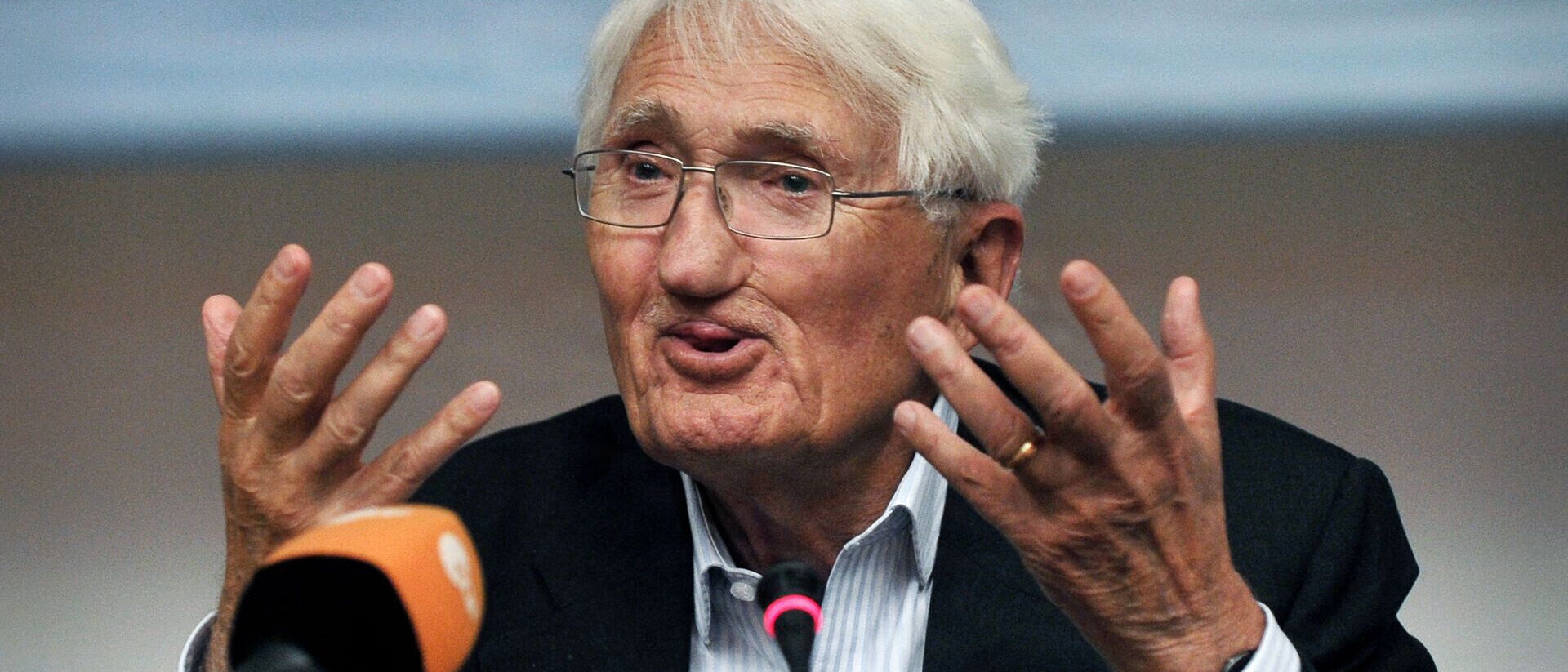
Photo: German philosopher Jürgen Habermas speaks to journalists in an auditorium at Athens School of Philosophy on August 6th 2013 (Louisa Gouliamaki/AFP/Ritzau Scanpix).