

In June 2026, a whopping 88 terawatt hours of electricity was traded on Epex Spot – Europe’s largest energy trading market.
This massive amount of energy – equivalent to more than twice the consumption of Denmark in a year – is bought and sold by energy traders who compete to offer the best price.
But increasingly, the traders are not human beings but algorithms that can work at lightning speed, 24 hours a day without rest.
This raises the question: Can humans keep up – and make sense – of such a complex system once algorithms take over?
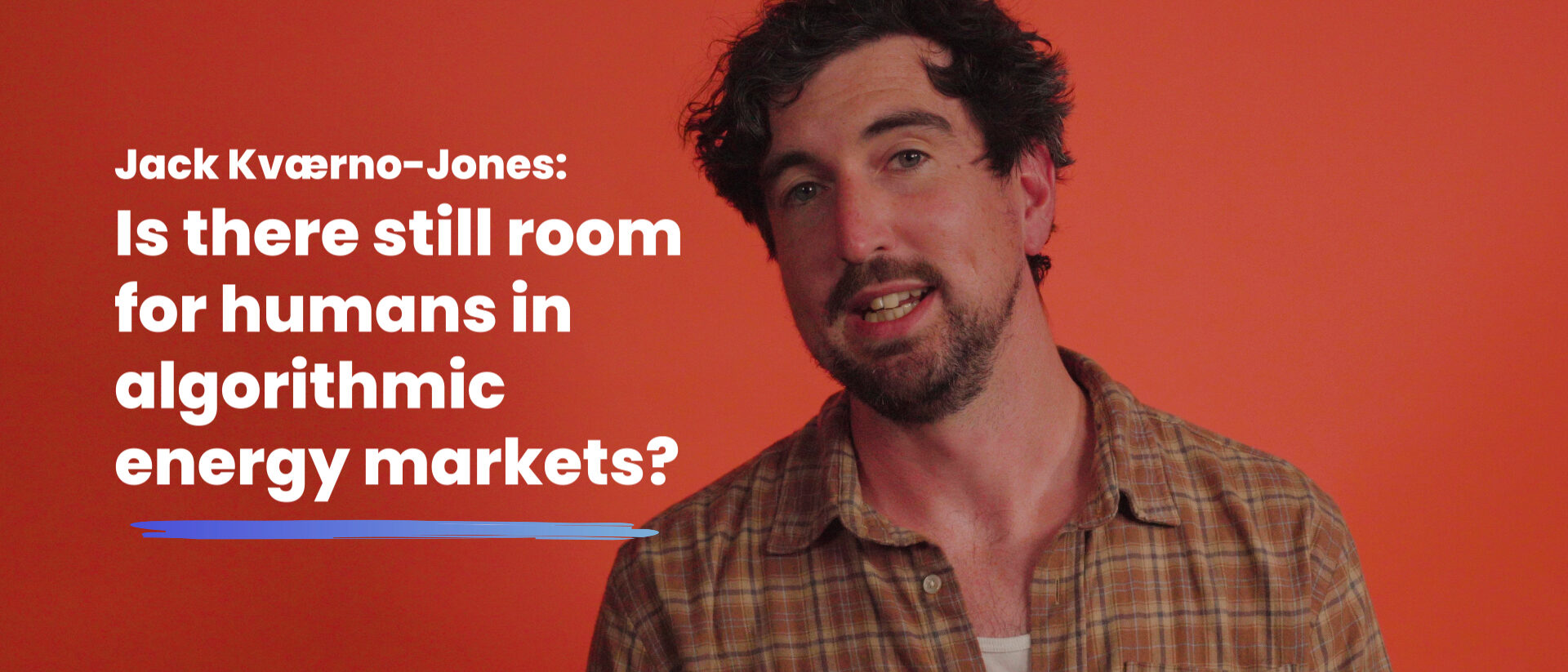
“Energy markets have for a while now been increasingly algorithmic,” says Jack Kværnø-Jones, a postdoc at Roskilde University and a new researcher with the ADD project.
“It can be an algorithm that is somewhat autonomous in sort of making decisions about the parameters around a trade. Or it could be algorithms and AI models that are used to sort of assist with making decisions around what kind of trading should be done.”
The humans in the machine
“The motivation for my research is to look at some of the underexplored organisational and professional sites that shape energy markets and to dig into the dilemmas and challenges that are raised by the increasing algorithmic nature of these markets,” Jack Kværnø-Jones says.
For instance: Can the professionals understand what the algorithms are doing when they trade electricity at huge volumes and make split-second decisions?
And how can regulations – which are based on an old system of human traders – stay relevant in an age of algorithmic markets?
To answer these questions, Jack Kværnø-Jones turned his attention to the humans in the machine. To study how people decide what counts as acceptable behaviour in algorithmic markets:
“My research is an ethnographic case study of a surveillance and compliance team within an energy trading firm. I’m looking at the everyday work of interpreting and trying to make sense of complex trading data.”
“So I am observing how professionals try to interpret trading behaviour in relation to existing regulations, in relation to established and approved code of algorithms, and in relation to the particular trading strategies,” Jack Kværnø-Jones says.
Is energy trading a moral market?
Energy trading was once an obscure, niche policy area, but has come under massive public scrutiny since the explosive inflation following the war in Ukraine in 2022. So could the increased use of algorithms further erode the system’s legitimacy?
“There have been various controversies with energy markets over the last few years with various energy crises that have happened that have hit people quite hard. I think in terms of these questions of legitimacy, there are different views on this,” Jack Kværnø-Jones says.
One view is that the markets should match supply and demand as efficiently as possible. This lends itself quite well to algorithmic execution, Jack Kværnø-Jones explains. But that does not necessarily equal public legitimacy:
“A lot of what’s happening in algorithmic markets is a kind of black box for the general public, right? And people just see prices going up, and they see firms making profits.”
“But what I’m looking at in this research is more the work of the people who are observing these markets from a kind of compliance and regulatory point of view. So these professionals are more concerned with maintaining orderly markets and ensuring that kind of regulation is upheld.”
“From my point of view, it’s interesting to see how our ideas on a more societal level of what constitutes a good market, we could even say a moral market, is in some way produced by the micro practices at the organisational level, as well as the particular technologies that are used in these contexts,” he says.
Algorithms have not replaced humans completely
Energy trading is not the only market where algorithms have displaced humans. According to a study from 2019, 92% of all trades in foreign currency were done by algorithms, and algorithmic trading is used extensively on the stock market as well.
Jack Kværnø-Jones hopes his research can help policy makers better understand how humans and algorithms collaborate in practice:
“I think the element of professional judgment is an important part of the work of surveillance professionals. They use complex software to flag alerts based on huge quantities of data from the markets. But once they get that alert, they still have to use their professional judgement to interpret what is happening in the data,” he says.
“And I think that is some of the value of this research: To point policy makers towards an understanding of the need – when making regulation – of also taking into account the interpretive human judgment involved in using AI and algorithms at the organisational level.”
In this way, Jack Kværnø-Jones hopes his research can contribute to the ongoing discussion about accountability of AI.
“I think this is clearly a debate that’s not going away any time soon. We have to find a way to understand how to regulate and produce accountability and legitimacy for these accelerating AI models at both the policy level and the organisational level.”
“Trying to understand how this happens at the organisational level, and the human judgment and interpretation that’s involved, is a necessary part of that.”
CV – Jack Kværnø-Jones
Postdoctoral researcher at Roskilde University, where he studies how algorithms and professional judgement shape how energy markets are interpreted, valued, and governed.
Has previously studied how banking and FinTech professionals imagine how technology will shape the future of finance and society.
When he’s not conducting research, he enjoys playing music, reading science fiction, and paddleboarding with his kids