


Impact lead: Carl Stefan Roth-Kirkegaard
Subproject: Innovation and democracy
Context
This subproject of the ADD project on innovation focus on understanding the status and implementation pathways of algorithms and AI in the context of leading Danish private corporations, and in turn, the future consequences this implementation holds for democratic power relations both in society and at work.
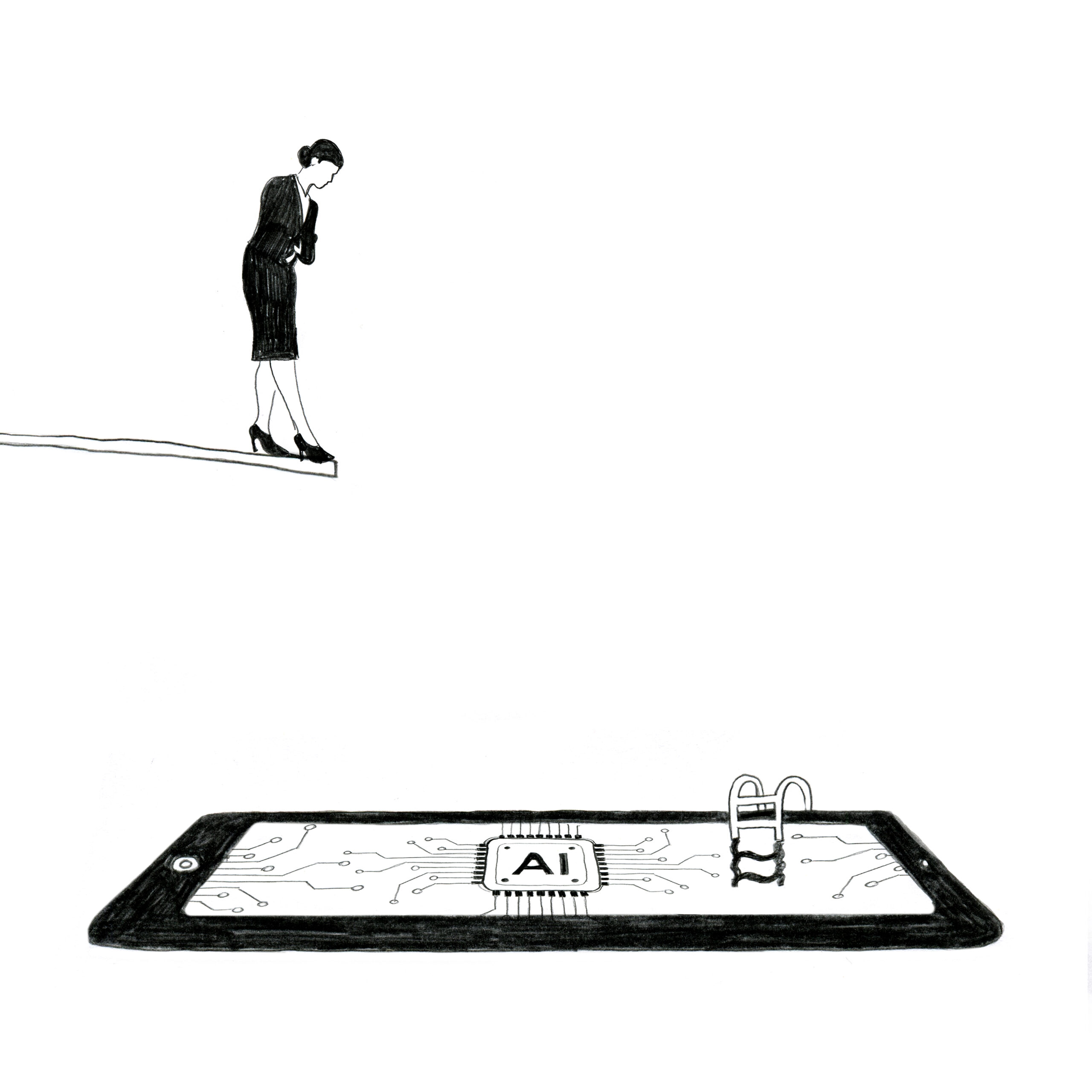
As AI and algorithmic systems increasingly shape private sector workflows and decision-making processes, Danish executives report significant transformations in organisational structures, employee roles, and customer relationships. Currently, organisations are finding it difficult to scale and broaden the use of customised AI products beyond specialised applications, and at the same time, the implementation of language modes has raised efficiency and freed up resources to engage in innovation, new tasks, or new servicing of customers. While this is seen by executives mostly as a positive development, both financially, for customers and for employees, they are also concerned about the long-term impact these technologies can have on power relations and socioeconomic relations in the broader society, where the fear is socio-economic instability due to unemployment and in their organisations that will lose human dispositions and values.
To mitigate the potential disruptive effects of algorithms and AI on power relations in the workplace, an important dimension the research team has explored is the way adoption of algorithms and AI is managed and led. The research team’s primary focus has been on the ways algorithms and AI might come to automate or augment work practices, and the technological and structural ways to ensure that adoption is benevolent. Executives in Danish companies are beginning to discuss the need for managers to have a more pronounced role in leading AI adoption. However, it has not yet been discussed broadly how managers can lead such changing circumstances. Furthermore, many managers lack the tools, confidence, and strategic guidance to oversee the responsible integration of AI. The research team has, through dialogues with companies since the advent of GenAI, experienced that the topic of algorithms and AI is less prevalent for competencies for managers, despite it being prevalent in the discourse surrounding labour market competencies presently. Managers have been reluctant to engage with the managerial role of regulating and encouraging specific AI uses and therefore risking uses that are not converging with the Danish democratic values, which the unmitigated adoption of AI might problematize.
Collaboration with the Danish Union Djøf
The research team is not the only one interested in unfolding the topic of AI adoption and managers, but it is also a prevalent topic for Djøf, a Danish union representing professionals in law, economics, public administration and business administration.
The union is divided between a regular union and a part of the union concerned with managers who are not owners and therefore have labour interests. While most labour unions are concerned with labour negotiations and general upskilling of their members, Djøf is especially concerned with upskilling because its members are engaged in knowledge-intensive work practices and are often organisationally close to the ownership structure of organisations, which makes aggressive labour negotiations less attractive.
This collaboration emerged from a research-partner matching session at the ADD conference in November 2024. Both Djøf and the research team identified a shared concern and interest: managers are underprepared to lead AI implementation efforts effectively. This mutual interest laid the groundwork for a partnership model of collaborative co-creation with Djøf providing stakeholder insights and a target group for the research team.
Djøf was interested in providing resources to their managerial members on the ways these members could improve their engagement with AI adoption and their readiness towards increased future adoption in their organisations.
In this case study, the research team, and in collaboration with Djøf, explores the guidelines between managerial work and algorithms and the broader relationship between management and leadership in organisations. To explore the relationship between managerial work and algorithms, the research team has applied sampling-based, network-based, and snowballing-based interview studies, mainly with corporate leaders and other relevant parties.
Pathways to impact
The research has mainly generated impact through stakeholder collaboration with the outcomes being distributed to practicing managers who lead AI adoption.
Collaboration with Djøf
Throughout the collaboration, Djøf and the research team had continuous dialogues where the research team’s existing findings were validated. One of the validated findings is that managers lack structured approaches to lead AI adoptions. Furthermore, the dialogues also reaffirmed the researchers’ assertion that middle managers are increasingly faced with managing AI adoption but do not feel they have the tools to manage such a process well. This validation was used to refine and ground the project’s output in real-world needs. As stated above, Djøf expressed their interest in a partnership with the researchers because they were interested in providing resources to their managerial members on the ways these members could improve their engagement with AI adoption and their readiness towards increased future adoption in their organisations.
By collaborating and partnering up with Djøf, the researchers secured embedded engagement. Furthermore, the collaboration featured knowledge exchange between Djøf and the research team.
Practical recommendations for managers
The specific outcome of the continuous dialogue with Djøf resulted in a set of practical recommendations for managers responsible for managing AI adoption, with a focus on how they should engage with AI adoption and lead AI adoption among their employees. Furthermore, the set of recommendations is directed towards a broad set of managers, as they should be relevant for both managers who have just started managing AI adoption and a reminder for managers with more experience with vital organisational aspects of an efficient and benevolent adoption. Below are the recommendations divided into two sections: General Recommendations for Leaders on Data and Recommendations for Leaders on Generative AI.


The research team has not received concrete evidence for the implementation of the recommendations as Djøf has not yet found a media outlet for them. That said, some of the suggestions in the above stated recommendations have been included in a campaign “AI for leaders” on Djøf’s website. This shows that the project has had some impact in the collaborator’s development of webinars and courses for managers working with AI.
Future impact
Initially, the research team is attempting to publish the above recommendations in a business-directed mainstream media in order to get the recommendations out to the public. Although managers as the target group might be difficult to reach by using membership-communicated communication, the goal is still to produce a text with the set of recommendations in a more specified and directed format towards managers.

The actual impact on managers working with AI adoption might be difficult to evaluate, but the research team will endeavour to collect feedback in collaboration with Djøf from the members to see if the recommendations are improving the resources available to managers in their engagement with algorithms and AI adoption. By collecting feedback together with Djøf laid the foundation for the research team to fine-tune and edit the recommendations and thereby further impact the way managers work with AI adoption.
Conclusion
The actual impact of the recommendations can be hard to evaluate, as the audience of the recommendations is external in relation to the research team. That said, the recommendations lay the foundation of instrumental actions to improve how managers in general and maybe especially middle managers work with AI adoption.
The research project has the potential to enhance the capacity for using the insights with the recommendations as a stepping stone for workshops for managers leading AI adoption, as they are the external key knowledge users.
This case demonstrates the impact that partnerships between researchers and stakeholders can have in shaping actionable responses to societal challenges, such as leading AI adoption in organisations. Key outcomes of the case:
- A growing awareness among managers of their critical role in AI governance
- Strengthened organisational capacity within Djøf to support its members’ AI leadership
- An evolving framework that allows managers to experiment with AI responsibility, while aligning practices with democratic values.
- The importance of conceptual clarity: By promoting a shared vocabulary and set of expectations around managerial responsibilities in AI adoption, it can reduce ambiguity and resistance among middle managers.
References
Acemoglu, D., Autor, D., Hazell, J., & Restrepo, P. (2022). Artificial intelligence and jobs: Evidence from online vacancies. Journal of Labor Economics, 40(S1), S293-S340.
Brynjolfsson, E. (2014). The second machine age: Work, progress, and prosperity in a time of brilliant technologies (Vol. 336). WW Norton & Company.
Fleming, P. (2019). Robots and organization studies: Why robots might not want to steal your job. Organization Studies, 40(1), 23-38.
Madsen, D. Ø., & Slåtten, K. (2018). HR-analyse som ledelseskonsept og ledelsesmote. Samfundslederskab i Skandinavien, 33(1), 42-68.
Raisch, S., & Krakowski, S. (2021). Artificial intelligence and management: The automation–augmentation paradox. Academy of management review, 46(1), 192-210.
Roth-Kirkegaard & Rehn (2025, forthcoming): On Pulsatile Dynamics, Arrhythmic Revolutions, and AI as an Event. In Rombach & Svärd (eds.), Debating the Speed of Organizational Change. Palgrave.
Roth-Kirkegaard & Rehn (2024, conference): Ideological imaginaries of identity, innovation and insecurity. On the complex politics of AI adoption. Organisation studies workshop: organization, organizing and politics. Mykonos.
Roth-Kirkegaard, Rehn & Fetteh (2023, conference): Three narratives of Artificial Intelligence adoption: Sense-making about Artificial Intelligence adoption consequences among executives in the Nordics. EGOS. Cagliari.
Smith, A. M., & Green, M. (2018). Artificial intelligence and the role of leadership. Journal of Leadership Studies, 12(3), 85-87.
Quaquebeke, N. V., & Gerpott, F. H. (2023). The now, new, and next of digital leadership: How Artificial Intelligence (AI) will take over and change leadership as we know it. Journal of Leadership & Organizational Studies, 30(3), 265-275.
| Read more about the subproject |
|---|
| AI for leaders on DJØF’s website: Examine what AI means for your leadership (Danish version) Rehn, A. Roth-Kirkegaard, C. S. (2026): On Pulsatile Dynamics, Arrhythmic Revolutions, and AI as an Event |