

In recent decades polarisation has risen sharply in many Western countries.
One way to understand this trend is to ask why polarisation is rising. Another is to show how it happens in practice.
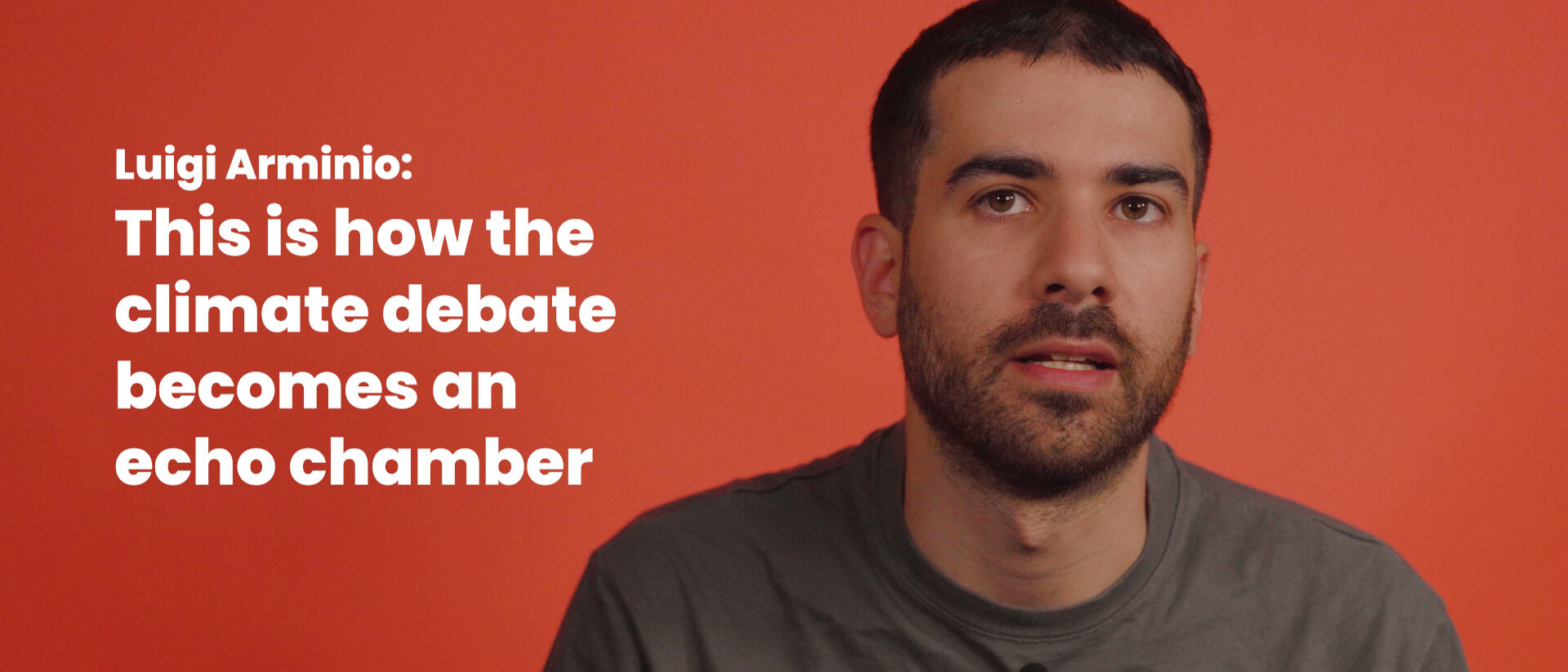
Luigi Arminio, a new postdoc researcher on the ADD project, is taking the second approach by showing – quite literally – how people are talking past each other:
“I studied the climate debate on Facebook, and I noticed how the actors involved in the climate debate tend to diverge in their style of communication, both in terms of how they communicate and the visuals they use,” he says.
By analysing more than 10,000 social media posts, he could show how pro climate actors tend to use images from nature – plants, flowers and animals – while the other side would focus on the negative downsides of the green transition:
“The pro-climate action actors focus on certain narratives that are nature-centric and the need for environmental action that takes into account animal rights, the preservation of forests and nature in general. On the other side, there seems to be more of a tendency to focus on the practical implication of climate policies for the population,” he explains.
The two sides rarely use the same images, and when they do, the emotional response is often markedly different. Combined with a difference in linguistic style the result is social media echo chambers where users talk past each other.
“Pro climate actors rely more on concrete, readable, and action-oriented language, while counter-actors display a comparatively more elaborate and defensive style marked by higher emotional tension and greater use of tentative or antagonistic cues,” as Luigi Arminio writes in his thesis from 2024.
A better way to communicate
Luigi Arminio hopes his research can help environmental organisations communicate more effectively:
“It’s important to understand how frustrations can make people more engaged by climate misinformation. Or how parts of the population can be triggered by climate denialism. Because if we understand this, we can also understand how to mitigate the misinformation and its harmful effects,” he says.
“We should try to understand how people end up believing in misinformation, and in this way I think environmental organisations can manage to build better empathy with the population if they know why they are not reaching everyone they would like to.”
Social media needs to be regulated
Polarisation is rising, but so is public interest in – and scrutiny of – polarisation. Not least fuelled by more than a decade of news articles and investigations into bot networks and influencing campaigns from foreign actors that pour gasoline on online debates to sow distrust in Western democracies.
Because of this, society should think hard about how to regulate social media platforms, Luigi Arminio says.
“We have the Digtial Services Act (DSA), but we are not the owners of the social media platforms that we are using as a European Union. I think that more research and investments are needed to create European social media platforms that follow the EU rules and have algorithmically transparent policies.”
He says that algorithmic transparency is crucial to spot bots, moderate content and reduce the influence of foreign actors. And the use of AI makes this a more pressing concern, Luigi Arminio says.
“These platforms use AI-enhanced recommender systems that we don’t control, that are owned by external companies, that can influence the way in which content is shared on social media and then can easily create echo chambers and more polarisation.”
“And that’s why I would insist on EU should find its own way to develop a platform, that could be public or semi-public, and that is completely reliable in terms of respecting the Digital Service Act and all the EU norms,” he argues.
AI is a polarising topic
Increasingly AI is also a topic for Luigi Arminio’s research. Both as a new technology that impacts how polarisation and misinformation spreads, but also as a polarising topic in itself:
“Just think about the way in which CEOs bringing AI innovation during graduation celebrations is causing a lot of negative reactions by the students, which can also relate, for example, to the unemployment crisis that can be related to AI. Let’s think about all the other issues that are bringing anger among the population, such as the issue with deepfakes and many other AI-related concerns.”
“So I would say AI is both a polarising topic and also a tool that can be used by external actors to drive more polarisation. And without proper regulation of generative AI, polarisation will grow even more,” he says.
CV: Luigi Arminio
- Postdoc at Roskilde University, where he is currently studying how AI contributes to polarisation on social media platforms
- In his PhD, Luigi Arminio investigates polarisation on social media using Visual Language Models to find new patterns among pro- and anti- climate actors
- When he is not researching, Luigi enjoys listening to music, attending live events, taking long walks, and watching football games.